


Gadchiroli pitched as Maharashtra’s future green steel hub India set to drive next global steel demand wave Italy crude steel output rises 3.1% in May Green steel progress remains slow worldwide
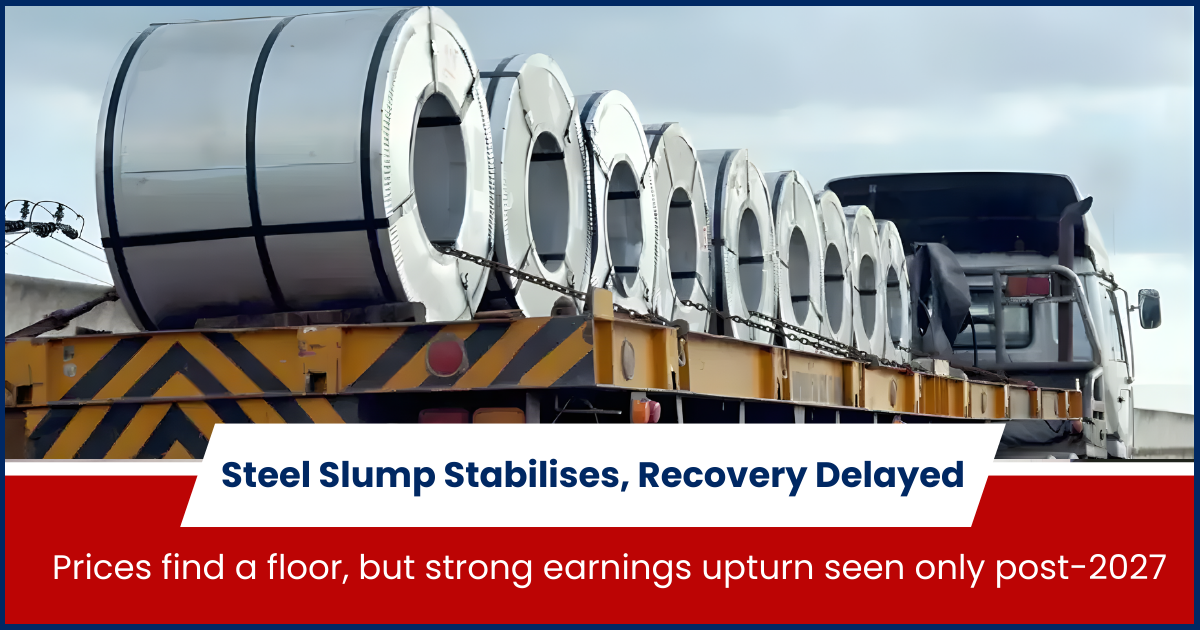
India’s steel sector is showing signs of stabilisation after a prolonged price slump, but a meaningful recovery in profitability remains some distance away, with analysts not expecting a clear upturn before 2027.
Hot-rolled coil (HRC) prices, the key benchmark for flat steel, briefly jumped to around ₹52,850 per tonne in April 2025 following the imposition of a 12% safeguard duty. Since then, prices have steadily retreated, slipping to about ₹49,500 per tonne in September and further to the ₹46,000 - 47,000 range by mid-November their lowest level in roughly five years.
The decline has compressed margins for major integrated steel producers and kept earnings growth under pressure, even as capacity additions continue. Smaller and highly leveraged mills are feeling the strain more acutely, with limited room to absorb further price shocks.
For now, the industry is leaning on three stabilising pillars: relatively steady domestic demand, benign raw material costs, and expectations that safeguard duties or other trade measures will be extended to keep cheap imports and dumping in check.
While these supports have helped steel prices find a tentative floor, sector watchers warn that oversupply risks, global demand uncertainty and the cost of decarbonisation could cap any sharp rebound. The near-term outlook is one of stabilisation rather than strong recovery, with a more durable upcycle likely only once new capacity is absorbed and demand broadens beyond core infrastructure and construction.
Also Read : India Seeks Fair Market Access for Steel and Aluminium 'Made in India' bullet trains with top speeds of 250 kmph in making

In a major push to India's infrastructure development, state-owned REC Ltd has declared its ambitiou...
Construction 10-Jan-2024
Industeel, a subsidiary of ArcelorMittal Downstream Solutions, has initiated the construction of a v...
Europe 13-Feb-2024
The World Trade Organisation has been officially informed by the European Union that the import safe...
Ferrous 31-May-2024
Iron ore prices moved higher as strong steel production and rising construction demand supporte...
China 22-Sep-2025
Fitch Ratings has revised the outlook on Indian steelmaker Tata Steel’s issuer default rating...
Business 19-Jul-2024
Tosyali Algerie, a prominent steel producer in Algeria, has recently inaugurated its second Direct R...
Africa 21-Feb-2024