


Gadchiroli pitched as Maharashtra’s future green steel hub India set to drive next global steel demand wave Italy crude steel output rises 3.1% in May Green steel progress remains slow worldwide
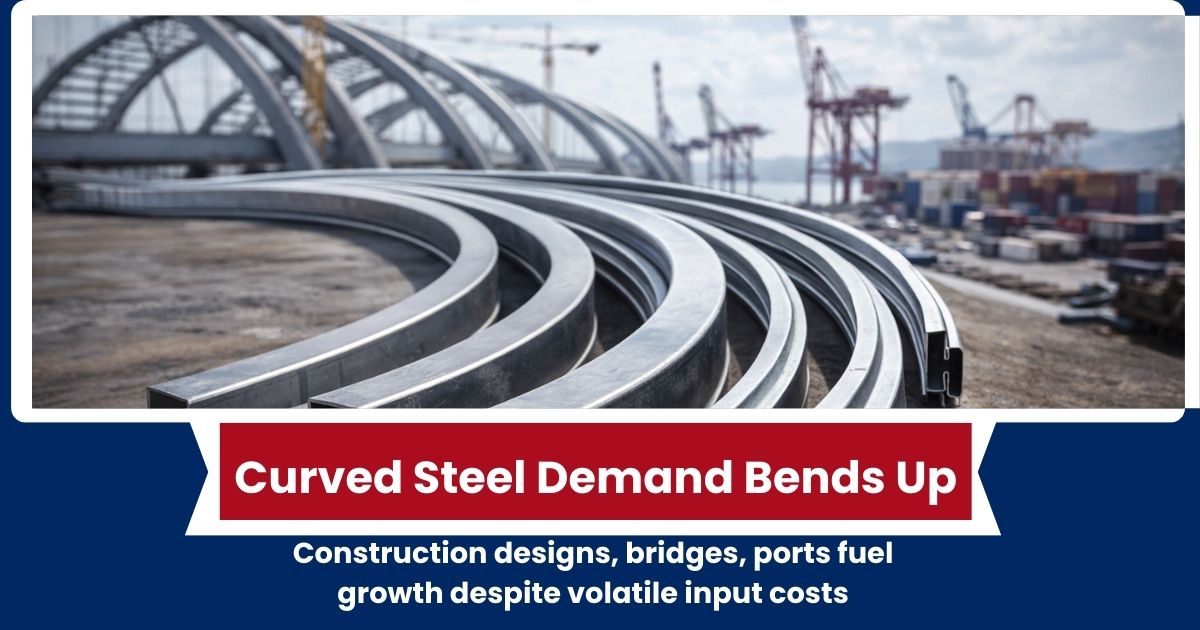
The global curved steel market is gaining momentum as builders and engineers increasingly use curved sections to deliver stronger, lighter, and more visually striking structures. Market estimates place the sector at about $3.8 billion in 2022, with projections rising to roughly $5.7 billion by 2032, supported by steady growth across the decade.
Demand is being powered by large-scale construction and infrastructure activity—especially bridges, ports, underground projects, stadiums, and commercial buildings. Architects are also leaning into modern, curved forms that require precision-bent steel in multiple profiles, including beams, channels, pipes, and tubes.
On the production side, bending methods such as induction bending, cold bending, rotary draw/compression bending, and point bending are helping fabricators meet tighter tolerances and faster project timelines.However, the market isn’t without challenges. Fluctuating raw material prices can pressure margins and impact project costs, especially for fabricators working on fixed-price contracts.Overall, curved steel is expected to remain a high-utility material choice for projects where design flexibility, structural performance, and long-term durability matter most.
Also Read : ₹6 Billion Boost: Bansal Wire to Set Up New Manufacturing Facility in Gujarat Tata explores Jaguar Land Rover EV imports, considers TN plant for JLR cars
Coal PSUs under the administrative control of The Ministry of Coal have been at the forefront of doi...
Renewables 21-Feb-2024
Automakers including Tesla, General Motors, Volkswagen and Toyota are failing to ensure they are not...
China 02-Feb-2024
The Pakistan Stock Exchange (PSX) recently experienced a significant drop in its index, declining by...
Asia 09-Feb-2024
Prime Minister Narendra Modi today will lay the foundation stone and dedicate railway projects worth...
Announcement 12-Mar-2024
India has revised its projections for peak electricity demand upward as energy consumption continues...
Announcement 26-Feb-2024
✅ Record-breaking output: MOIL achieves its highest-ever manganese ore production in FY 2024-25.✅...
Business 04-Apr-2025