


Gadchiroli pitched as Maharashtra’s future green steel hub India set to drive next global steel demand wave Italy crude steel output rises 3.1% in May Green steel progress remains slow worldwide
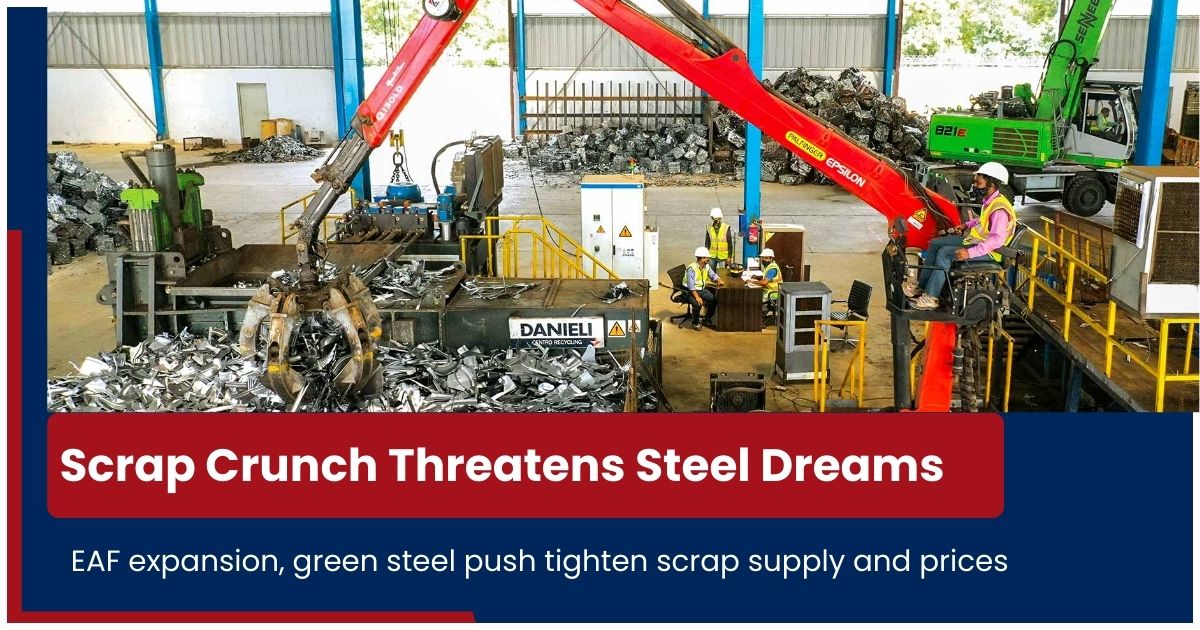
India’s push to expand steel capacity while cutting emissions is running into a growing bottleneck: steel scrap. As producers add more electric arc furnace (EAF) and scrap-based capacity to meet green steel goals, demand for ferrous scrap is rising faster than reliable supply.
The challenge is structural. Domestic scrap collection is still highly fragmented, with limited organised sorting, shredding, and processing. End-of-life vehicles and industrial scrap that could feed cleaner steelmaking are not flowing into formal channels at the required scale, keeping availability tight and costs elevated. At the same time, global scrap supply is getting more competitive, with trade restrictions and shifting export policies in key regions making imports less predictable.
For steelmakers, this means higher input costs, tighter procurement, and greater exposure to volatility—especially for plants planning to increase scrap usage. To bridge the gap, companies and policymakers are ramping up formal recycling networks, investing in scrap-processing capacity, and expanding vehicle scrappage and circular economy infrastructure. In the near term, however, import dependence is likely to increase, making scrap security a central theme in India’s steel growth story.
Also Read : Germany’s Steel Output Slumps 10.1% YoY in April 2025 New Rolling Mill in Ludhiana Set to Boost Steel Production by April 2025
Tit For Tat - India Set To Impose Tariffs On U.S. India is preparing to impose retaliatory tar...
US 11-Aug-2025
Industeel, a subsidiary of ArcelorMittal Downstream Solutions, has initiated the construction of a v...
Europe 13-Feb-2024
Nippon Steel, Japan's largest steelmaker, has disclosed that country's three major banks, Sumitomo M...
Business 31-Jan-2024
Hindustan Copper Limited (HSL), a state-owned company, reported that its copper concentrate output i...
Large Corporate 03-Apr-2024
Delhi's BSES Rajdhani, BSES Yamuna, Tata Power Delhi, and Noida Power secured top ratings in power d...
Mid Corporate 20-Jan-2024
The Indian government has declared a surge in windfall tax on petroleum crude from ₹6,800 to ₹9,600...
Taxation 16-Apr-2024