


Gadchiroli pitched as Maharashtra’s future green steel hub India set to drive next global steel demand wave Italy crude steel output rises 3.1% in May Green steel progress remains slow worldwide
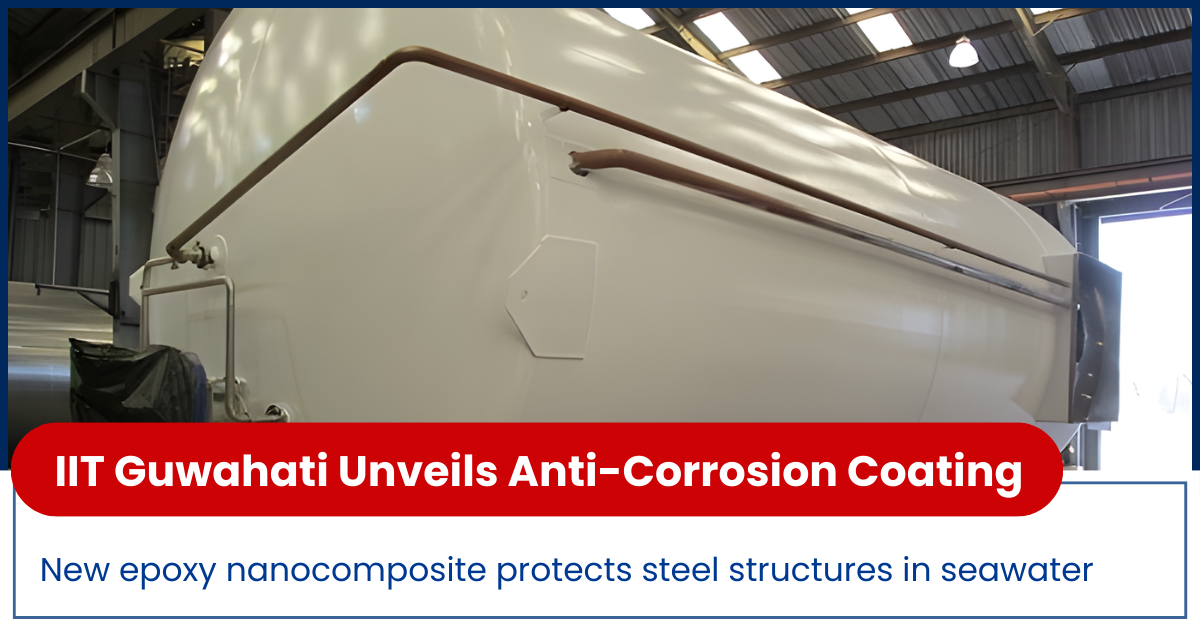
Researchers at the Indian Institute of Technology (IIT) Guwahati have developed a corrosion-resistant epoxy coating designed to protect steel structures exposed to seawater and high-salinity environments.
Corrosion in marine conditions severely weakens steel used in offshore platforms, coastal bridges, port infrastructure and pipelines, shortening service life and creating safety and environmental risks. Conventional barrier coatings often develop microscopic defects over time, allowing moisture and salts to penetrate and attack the underlying metal.
To address this, the IIT Guwahati team created a nanocomposite by combining reduced graphene oxide (RGO), zinc oxide (ZnO) nanorods and the conducting polymer polyaniline (PANI), and dispersing this composite in an epoxy matrix. Laboratory tests show that the new coating forms a denser, more uniform barrier than standard epoxy, adheres more strongly to steel surfaces and slows the ingress of corrosive elements more effectively.
According to the researchers, these properties make the coating promising for marine infrastructure, offshore and shipbuilding applications, as well as coastal pipelines and other steel assets exposed to saltwater. The work, published in the journal Advanced Engineering Materials, is currently at the laboratory stage. The team plans further studies on long-term durability, real-world performance and life-cycle impacts before the technology can move toward commercial deployment.
Also Read : New Proposal: GOI working to impose 30% export tax on low-grade iron ore JSW Steel to Auction 20,000 Tonnes of Iron Ore CLO from Odisha
The UK-based IT solutions firm CarbonChain and the international distributor of materials and servic...
Europe 30-Jan-2024
India has indicated that it may reconsider certain tariff concessions granted to the United Kingdom...
Business 02-Jun-2026
Trump opposes U.S. Steel's foreign acquisition to safeguard national industry. Political and union...
US 14-Apr-2025
Odisha is poised to receive an additional 1,463 MW of power from the National Thermal Power Corporat...
Energy 02-Feb-2024
India’s steel demand is expected to witness double-digit growth in the second half of FY25, dr...
India 08-Sep-2025
Steel MSMEs may experience a deceleration in growth for the current financial year, according to the...
Business 23-Aug-2024