


Gadchiroli pitched as Maharashtra’s future green steel hub India set to drive next global steel demand wave Italy crude steel output rises 3.1% in May Green steel progress remains slow worldwide
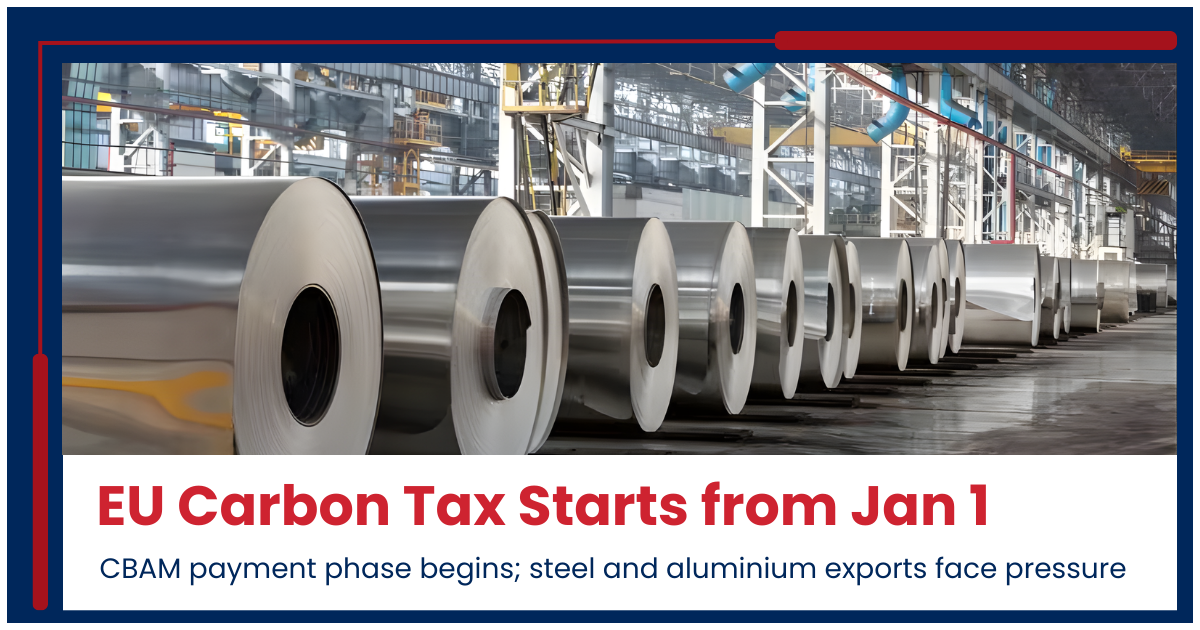
The EU’s Carbon Border Adjustment Mechanism (CBAM) moves into its definitive (payment) phase from January 1, 2026, meaning covered imports such as steel and aluminium entering the EU will carry an emissions-linked carbon cost.
India-focused think tank GTRI warns the shift could compress margins for Indian exporters, estimating that many may need to cut prices by ~15–22% so EU buyers can accommodate the CBAM cost. Under CBAM, EU importers (authorised CBAM declarants) buy certificates linked to the embedded emissions in imported goods, but the cost is expected to be passed back through pricing to suppliers.
GTRI highlights that emissions intensity matters: in steel, BF–BOF routes are highest, while DRI is lower and scrap-EAF is lowest; in aluminium, the electricity source is a critical driver of carbon burden.The note also stresses compliance: exporters must maintain installation-level emissions accounting, and from 2026 third-party verification becomes mandatory otherwise the EU may apply conservative default values, potentially 30–80% higher than actual emissions
India’s steel and aluminium exports to the EU fell 24.4% in FY25 to $5.82 billion, and CBAM remains a key friction point in India-EU trade discussions.
Also Read : German Steel Federation Welcomes EU’s New Steel Safeguard Quota Measures EUROFER warns CBAM fixes still fall short of protecting EU steel
The Cabinet Committee on Economic Affairs (CCEA) authorised Coal India Limited's (CIL) application t...
Renewables 25-Jan-2024
According to a report by India Rating and Research (Ind-Ra), thermal power is poised to remain a cru...
Energy 26-Feb-2024
India is deepening its trade partnership with Russia to import specialty steel grades, as European a...
India 28-Oct-2025
According to Minister of Housing and Urban Affairs Hardeep Singh Puri, India's rapidly expanding con...
Construction 20-Feb-2024
✅ Steel imports may fall by 50% in FY25/26 due to safeguard duty✅ Policy shift to protect domestic...
Business 25-Mar-2025
Global Steel Output Falls 3.8% in May as Demand Slows Global crude steel production declined by 3.8...
Business 24-Jun-2025